
Quick Definition
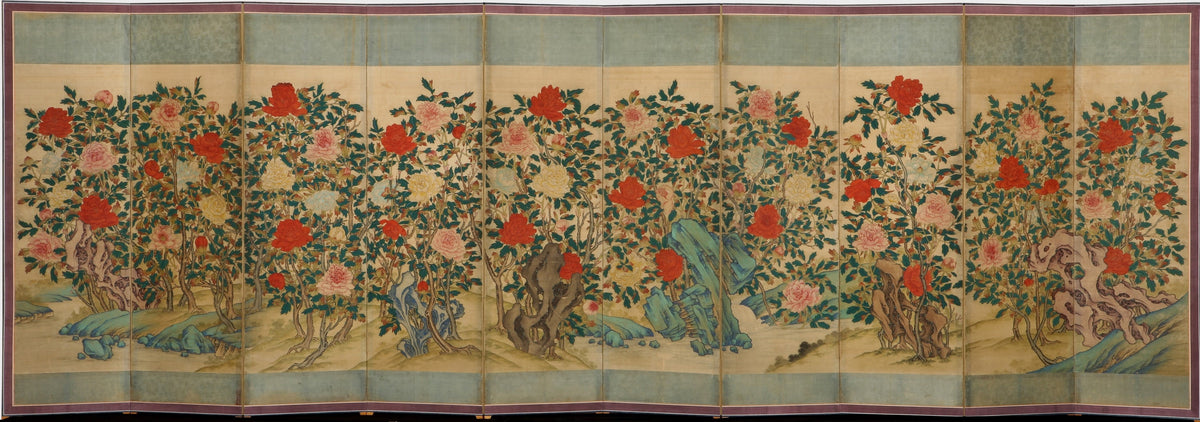
Minhwa (민화) — from min (민, commoner) and hwa (화, painting) — is traditional Korean folk painting produced from the Joseon Dynasty onward. Unlike formal court painting, Minhwa was the art of everyday people: vibrant, symbolic, and filled with wishes for good fortune, longevity, love, and protection. Peonies, tigers, magpies, cranes, fish, and the Ten Symbols of Longevity are among its most recognisable subjects.
Running a Korean houseware brand in Melbourne, I spend most of my days thinking about how to bring Korean craft to Australian homes. But sometimes I need to stop thinking and start doing. A few months ago, I walked into a Minhwa studio in Melbourne, sat down at a table lined with natural pigments and Korean brushes, and spent an afternoon learning — really learning — what it feels like to make something by hand in the Korean tradition.
I chose to paint a peony (moranmundo, 모란도). It is my wife’s favourite flower. It also happens to be one of the most powerful symbols in Korean folk art: abundance, nobility, and beauty without apology. (I should note I was also making up for forgetting our anniversary flowers. The peony felt appropriate.)
This is what I experienced — and what I learnt about a 500-year-old art form that still has plenty to say.
▶ Watch: My Minhwa Journey
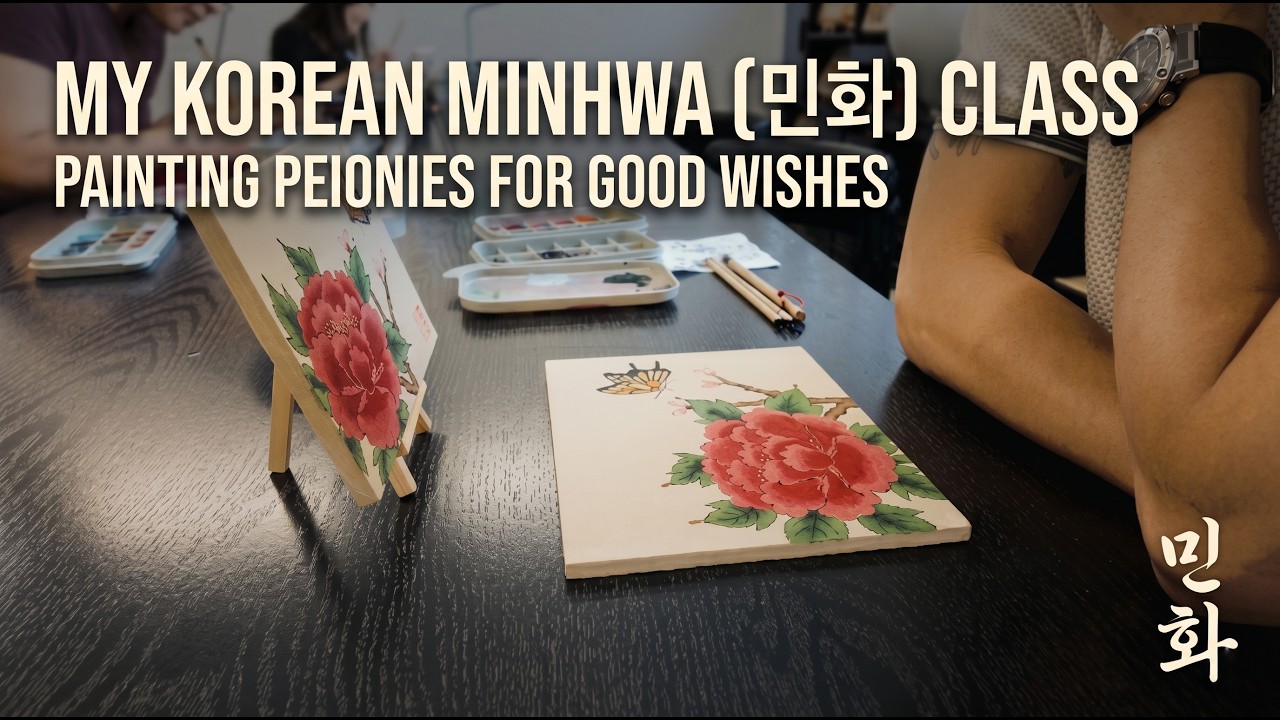
Watch the full experience — painting Minhwa at a Melbourne studio (PEUM YouTube)
What Is Minhwa? A Brief History
Minhwa flourished during the Joseon Dynasty (1392–1897), a period when the court controlled formal fine art — ink landscape paintings, official portraits, ceremonial works. Minhwa was everything the court was not. It was made by anonymous artisans and everyday people, displayed in homes and markets, given as gifts, hung on walls to bring good luck and ward off evil.
The subjects of Minhwa were chosen for their symbolic meaning rather than their painterly prestige:
| Subject | Symbolism |
|---|---|
| Peony (모란) | Wealth, nobility, abundance, feminine beauty |
| Tiger (호랑이) | Protection, guardian spirit, warding off evil |
| Magpie (까치) | Good news, joy, happiness arriving |
| Crane (학) | Longevity, wisdom, nobility |
| Carp / Fish (물고기) | Abundance, perseverance, success in exams |
| Ten Longevity Symbols (십장생) | Long life — sun, water, clouds, pine, bamboo, crane, deer, tortoise, peach, fungus |
Minhwa was not fine art by the standards of the Joseon court. It was not signed. It was not commissioned by kings. But it was everywhere — in households, in markets, on the walls of ordinary Korean life — and it carried something court painting often lacked: genuine feeling. People painted what they hoped for.
▶ Minhwa Overview
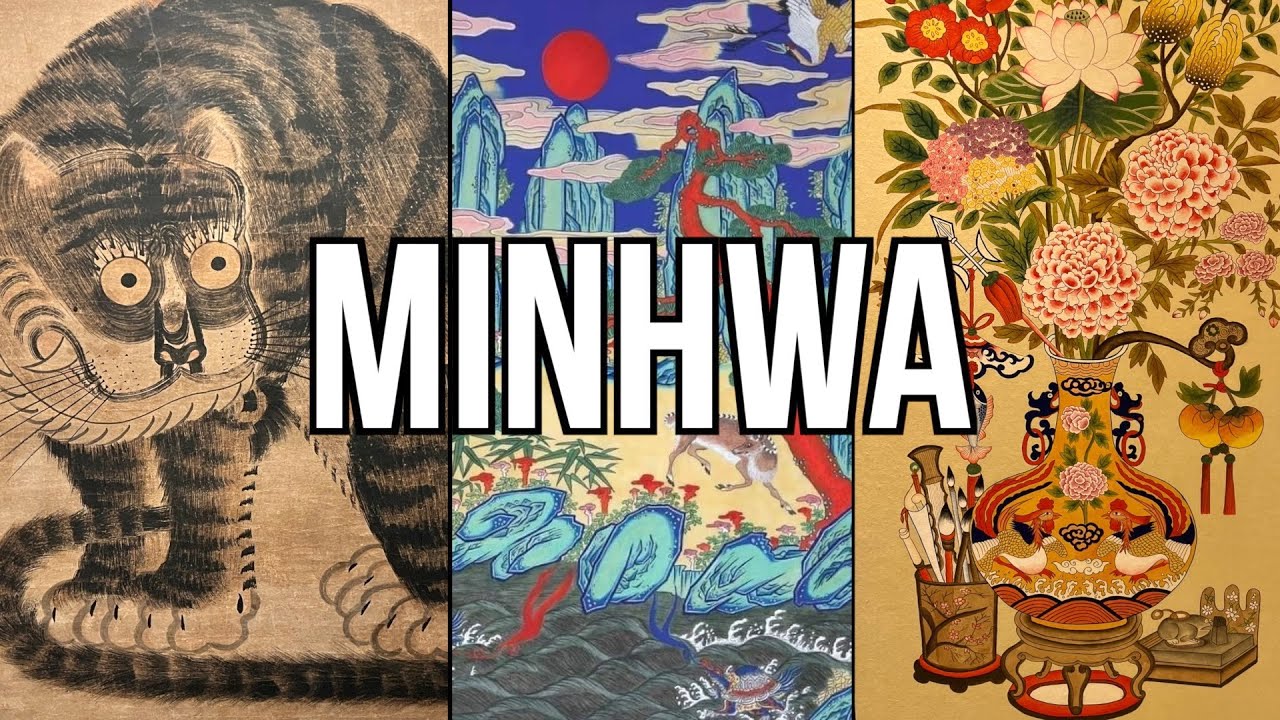
Korean Folk Art and Painting: Minhwa 민화, An Overview — history, symbolism, and technique (YouTube)
The Three Techniques I Learnt That Afternoon
What struck me most in the studio was how structured the process is. Minhwa has a clear technical grammar, and every mark has a name and a purpose.
Chaeseok (채색) — Layering the Base Colours. The first step is applying flat base colours across the composition. Minhwa uses mineral and natural pigments — ground azurite for blue, malachite for green, vermillion for red. These are diluted and layered repeatedly, building colour gradually rather than applying it in a single heavy coat. The layering gives Minhwa its characteristic luminosity.
Barim (바림) — The Korean Gradation Technique. This is the technique that defines Minhwa and has no direct equivalent in Western painting traditions. While colour is still wet, a clean dry brush is used to blend it at the edges, creating a soft gradient that fades from saturated to almost nothing. The result is a sense of depth and three-dimensionality achieved without shadow or perspective in the Western sense. I spent most of the afternoon attempting this. It felt — and the instructor confirmed — like it takes years to master properly.
Seongreegi (선그리기) — The Final Line Work. Once the colour layers are dry, fine ink lines are drawn over the top to define the forms. This is the moment when the painting finds its character — the lines give the petals, stems, and leaves their energy and precision. A good Minhwa line has tension: not rigid, not hesitant, but confident and alive.
▶ Minhwa in Depth

Minhwa: Marvelous Korean Folk Paintings — an in-depth exploration with art historian Byumngmo Chung (YouTube)
Why It Matters — in Melbourne
Learning Minhwa in Melbourne felt like finding a thread I did not know I had dropped. I have been living in Australia for years, running a business that is entirely about Korean craft, and it is easy to get caught up in logistics and marketing and forget that these objects have a living practice behind them — people who still sit down and paint, who still choose the peony because their grandmother chose the peony.
Art is not just a hobby. Every Minhwa painting is a vessel for what the painter hopes for. That is why the subjects matter: you do not paint a tiger by accident. You paint it because you want protection. You paint a peony because you want abundance. You pour something real into every stroke.
Melbourne has a growing Korean community and a genuine appetite for Korean cultural experiences. Minhwa workshops are happening here. If you have never tried it, I recommend finding one. It will slow you down in the best possible way.
Frequently Asked Questions About Minhwa
What is Minhwa (민화)?
Minhwa is traditional Korean folk painting produced primarily during the Joseon Dynasty (1392–1897). Unlike formal court art, Minhwa was made by and for ordinary people. It features vivid colours, symbolic subjects (peonies, tigers, cranes, fish), and a distinctive gradation technique called barim. The name means “painting of the people.”
What are the most common subjects in Minhwa?
The most common subjects are peonies (abundance, nobility), tigers (protection), magpies with tigers (good news and warding off evil), cranes (longevity), carp (perseverance and success), and the Ten Symbols of Longevity (십장생). Each subject carries specific symbolic meaning and was chosen intentionally by the painter.
What is the barim (바림) technique?
Barim is the defining gradation technique of Minhwa. While pigment is still wet, a clean dry brush blends the colour at the edges, creating a soft fade from saturated to transparent. This creates depth and three-dimensionality without using Western concepts of shadow or perspective. Barim is considered one of the most technically demanding aspects of Minhwa and takes years to master.
Can I learn Minhwa in Australia?
Yes. Minhwa workshops are offered in Melbourne and Sydney through Korean cultural centres and independent studios. No prior art experience is necessary for beginner workshops. The meditative, structured nature of Minhwa makes it accessible for adults of all backgrounds.
Is Minhwa still practised today?
Yes. Minhwa has experienced a significant revival in Korea since the 1970s and is now practised and taught internationally. Contemporary Minhwa artists combine traditional techniques with modern subjects and formats, and the art form is gaining recognition in galleries and cultural institutions worldwide.
Stay tuned as I continue sharing the beauty of Korean heritage and artisan craft here in Australia. The thread is long, and there is more to follow.