
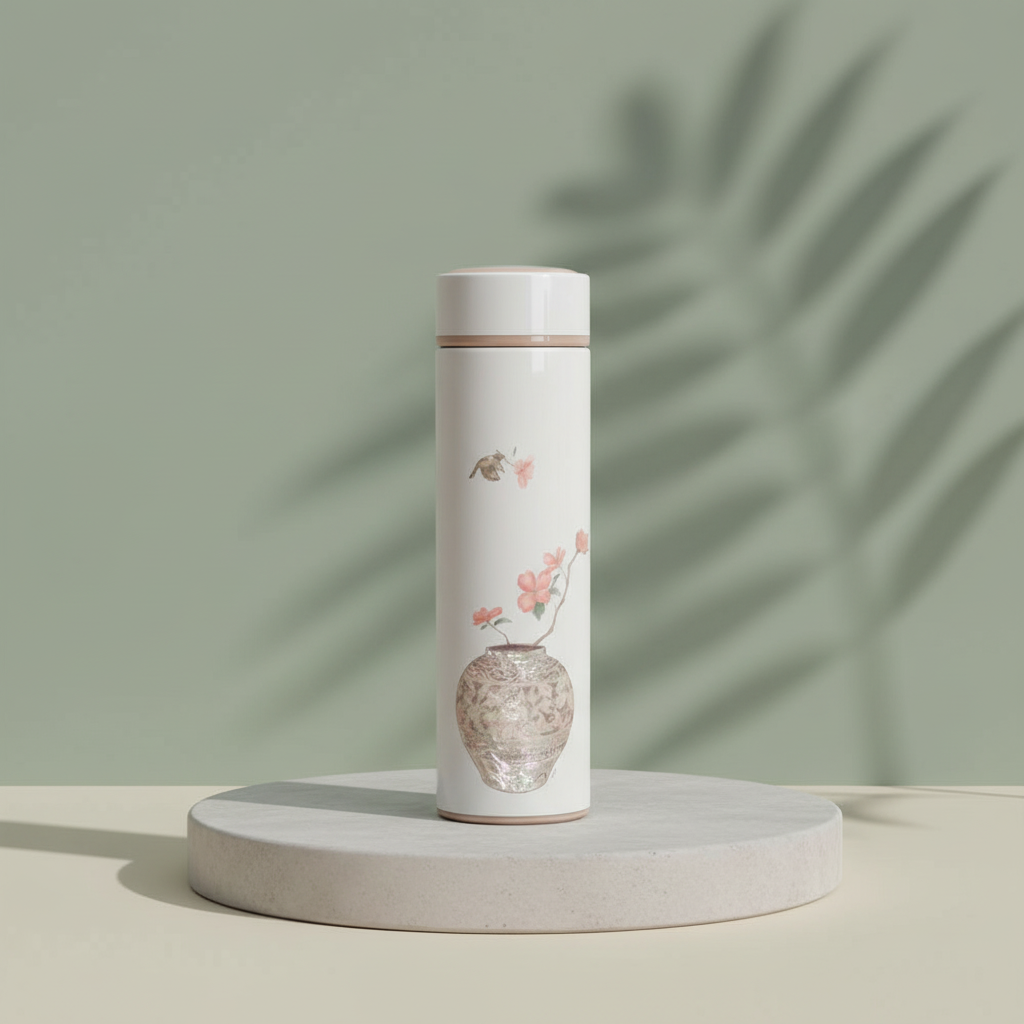
[Jang-i] Mother-of-Pearl Peony Hwabyeongdo – Heritage Insulated Tumbler (450ml)
Shaped with a maker's heart, it finds new meaning in your everyday.
A quiet piece of Korea, brought into life in Australia.
Specifications
Materials
Artisan Info
Care Instructions
Shipping & Returns
Ships directly from South Korea to Australia
Delivery 5–14 business days (incl. 1–3 days processing),
depending on destination & customs clearance
Made-to-Order Some items need up to 2 extra weeks
— noted on product page
Shipping Fees (shown in your local currency)
- Orders AUD 200 and over → Complimentary shipping 🎁
- Orders under AUD 200 → Flat rate AUD 30
📦 No PO Boxes or Parcel Lockers · Tracking emailed on dispatch
International orders may incur customs duties
In the old paintings, the peony didn't announce itself. It simply occupied the centre of the composition, and everything else arranged itself around it.
Jang-i's Peony Hwabyeongdo tumbler is drawn from the world of Buncheong-sagi — the rustic, understated Korean stoneware of the Joseon era — reimagined through the Najeonchilgi lacquerware technique. Two types of shell are hand-inlaid to produce the peony's characteristic depth: Saek-pae Korean abalone for its bold spectrum of red and blue, and Sinbal-pae for its quieter, rainbow iridescence. The result is a surface that shifts meaning with every angle — the same quality that makes Joseon flower-and-bird paintings, the Hwabyeongdo, endlessly returnable.
On a timber or stone kitchen surface, the Joseon palette reads as contemporary without effort, sitting comfortably in an interior that values material honesty. On a desk in a quiet office, the peony's symbolism of abundance and nobility works as ambient intention rather than decoration. Given to mark love, gratitude, or a milestone — the peony in Korean culture has always carried exactly those meanings — it arrives without needing explanation. PEUM carries this not as a souvenir of a tradition, but as the tradition itself: the same craft, the same materials, the same intention.
Double-walled vacuum insulation, food-grade stainless steel, premium packaging included. An object that holds its meaning as long as you hold it. Handcrafted in South Korea — made for those who know the difference.
Thank you for visiting PEUM.
At PEUM, we’re passionate about sharing the beauty and soul of Korean artisan craftsmanship with the world.
Each item is thoughtfully handled and carefully packed by hands that respect the story behind every piece so that it reaches your home just as it was meant to be.
We’re a small, independent team that believes in doing things properly with care, with purpose, and with heart.
No shortcuts, no compromises
just genuine dedication to bringing you something special, the way it deserves to be delivered.
With warmth,
PEUM을 찾아주셔서 진심으로 감사드립니다.