
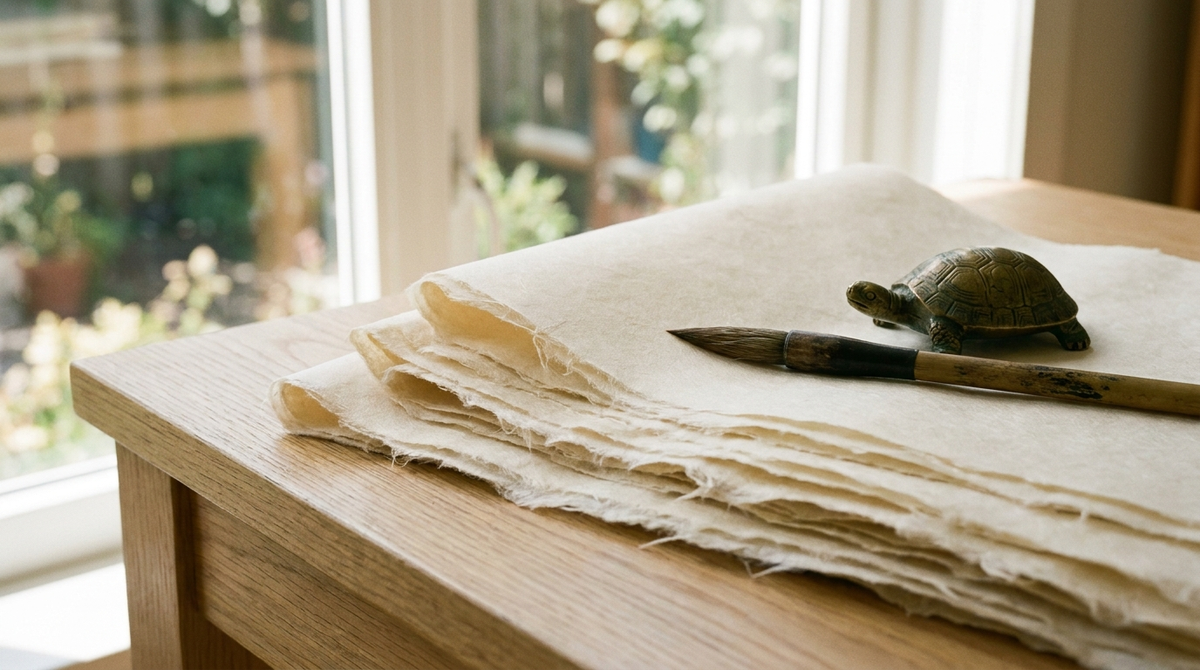
Quick Definition
Hanji (한지) is traditional Korean handmade paper made from the inner bark of the paper mulberry tree (Broussonetia papyrifera). Produced using an 18-stage hand process, Hanji has a pH of 7–8 (alkaline), fibres up to 10mm long, and a documented lifespan exceeding 1,000 years — making it the most durable paper ever created. It is currently used in conservation at the Louvre, the V&A Museum, and major European archives.
“Paper lasts a thousand years, silk lasts five hundred.” This ancient Korean saying was not poetic exaggeration — it was a statement of fact. While acid-laden Western paper crumbles within centuries, Hanji documents from the Goryeo Dynasty (918–1392) remain intact today, their ink vivid, their fibres supple.
Hanji is not simply paper. It is a living material — breathing, self-regulating, and extraordinarily resilient. And right now, the world is paying attention.
A History Spanning Two Thousand Years
The origins of Hanji trace back to the Three Kingdoms period (57 BC–668 AD), when Korean artisans adapted Chinese papermaking techniques to suit the native mulberry tree and the cool mountain streams of the Korean peninsula. The result was a paper so superior that ancient Chinese texts described Silla paper as “incomparable under heaven.”
During the Goryeo period, the invention of movable metal type created an explosion in paper demand. Hanji became a prized export across Asia — historical records even document Joseon-era Hanji lining the windows of the Forbidden City in Beijing, the imperial court of China preferring Korean paper over their own.
“The paper of Joseon is white as silk, strong as leather, and the ink sinks into it like the grain of skin.”— Ming Dynasty Chinese scholar
In 1415, the Joseon government established the Jojiso (造紙所) — a state-run paper manufacturing bureau — cementing Hanji as a national institution. By the 15th–16th centuries, Korea was producing paper on an industrial scale for government records, Buddhist texts, maps, and diplomatic correspondence.
▶ Watch Documentary
Hanji Premium Documentary — the history and extraordinary lifespan of Korea’s legendary paper (YouTube)
How Hanji Is Made: The 18-Stage Hand Process
Creating a single sheet of Hanji requires no fewer than 18 distinct stages, each performed entirely by hand. No machines. No shortcuts. The full process takes several days from start to finish.
| Stage | What Happens | Why It Matters |
|---|---|---|
| 1. Harvest | Mulberry branches cut in late winter | Winter bark has highest fibre density |
| 2. Steam | Branches steamed to loosen bark | Preserves fibre integrity |
| 3. Peel | Outer bark removed; inner white bark kept | Only the purest fibres are used |
| 4. Lye boil | Inner bark boiled in alkaline ash water | Removes lignin; sets pH 7–8; key to longevity |
| 5. Wash | Rinsed in cold running water | Removes residual chemicals naturally |
| 6. Beat (Gohai) | Fibres beaten thousands of times on stone | Creates fine, even pulp; activates bonding |
| 7. Mix with Hanji-pul | Pulp mixed with natural mucilage | Even fibre distribution; natural preservative |
| 8. Choiji (paper-lifting) | Multi-directional scooping on bamboo screen | Fibres run in all directions = superior strength |
| 9. Press & dry | Pressed overnight; dried on heated boards | Final moisture removal; surface finish |
▶ Watch Documentary
MBC Documentary — ‘Hanji: A Two-Thousand Year Journey’ · Goryeoji, the Greatest Paper Under Heaven (YouTube)
Why Hanji Lasts Over 1,000 Years: The Science
1. Fibre length. Mulberry fibres reach up to 10mm, versus 1–3mm for wood pulp. Longer fibres create a denser, more interlocked matrix — resulting in paper up to three times stronger than equivalent Western paper by weight.
2. Alkalinity (pH 7–8). The lye-boiling stage gives Hanji a neutral to slightly alkaline pH. Western paper, bleached with acidic agents, undergoes acid hydrolysis over time — its own acids breaking down the cellulose. Hanji’s alkalinity buffers against this entirely. This is why 800-year-old Hanji manuscripts are still flexible, while 150-year-old European newspapers crumble at a touch.
3. Multi-directional fibre structure. The choiji technique produces fibres running in all directions simultaneously — unlike Western machine-made paper, where fibres run in a single direction and tear easily along the grain. Hanji has no grain. It tears evenly in every direction, and resists mechanical stress from any angle.
4. Hanji-pul (natural preservative). The mucilage from Hibiscus manihot roots fills microscopic gaps between fibres, repelling moisture, insects, and mould. No synthetic biocides required.
Hanji vs Western Paper vs Japanese Washi
| Property | Hanji | Western Paper | Japanese Washi |
|---|---|---|---|
| Raw material | Mulberry bark | Wood pulp | Mulberry / Gampi |
| Fibre length | Up to 10mm | 1–3mm | Up to 8mm |
| pH | 7–8 (alkaline) | 4–5 (acidic) | 6–7 (neutral) |
| Fibre direction | Multi-directional | Single direction | Single direction |
| Estimated lifespan | 1,000+ years | 100–200 years | 500–800 years |
| UNESCO listed | Pending (2024–) | — | Yes (2014) |
| Used in museum conservation | Yes (Louvre, V&A) | No | Yes |
Hanji in the Modern World
Far from being a relic, Hanji is having a remarkable renaissance across multiple industries:
Art conservation. The Louvre, the Victoria & Albert Museum, and the Vatican Library now use Hanji as a preferred conservation material for restoring damaged oil paintings, parchment manuscripts, and ancient textiles. Its alkaline pH, thinness, and strength make it superior to Western restoration papers for lining and backing fragile works.
Fashion & textiles. Hanji fibre has been spun into wearable yarn and woven into fabric. The resulting textile is lighter than linen, more breathable than cotton, naturally antibacterial, and UV-resistant. Designers in Korea, Japan, and Europe have incorporated Hanji textiles into ready-to-wear collections.
Medical research. The porous microstructure and biocompatibility of Hanji are being investigated for wound dressings, surgical sutures, and drug delivery membranes. Early research at Korean universities shows promising results in biodegradable medical applications.
Architecture & interiors. Hanji has been used for centuries in Korean architecture as a wall and floor covering (Hanji wallpaper, Hanji flooring). Its hygroscopic properties — absorbing moisture when humidity rises and releasing it when the air is dry — act as a natural humidity regulator, reducing condensation and improving indoor air quality.
“Hanji is not old paper. It is a living material — it breathes, regulates humidity, and grows stronger with time.”— Kim Il-su, Jeonju Hanji Master Artisan
UNESCO Recognition & Sustainability
In 2024, Korea formally accelerated its campaign to have Hanji recognised as a UNESCO Intangible Cultural Heritage. Japan’s washi was listed in 2014; Korea’s Hanji community is united in making the case that Korean paper — older, stronger, and more technically sophisticated — deserves equal recognition.
The environmental case is equally strong. Mulberry trees regenerate fully within 3–5 years of harvesting. The production process uses no synthetic bleaches, no optical brighteners, and no petrochemical binders. The finished paper is fully compostable. In an era of plastic-free and zero-waste design, Hanji is not a nostalgic alternative — it is a material solution.
▶ Watch on YouTube
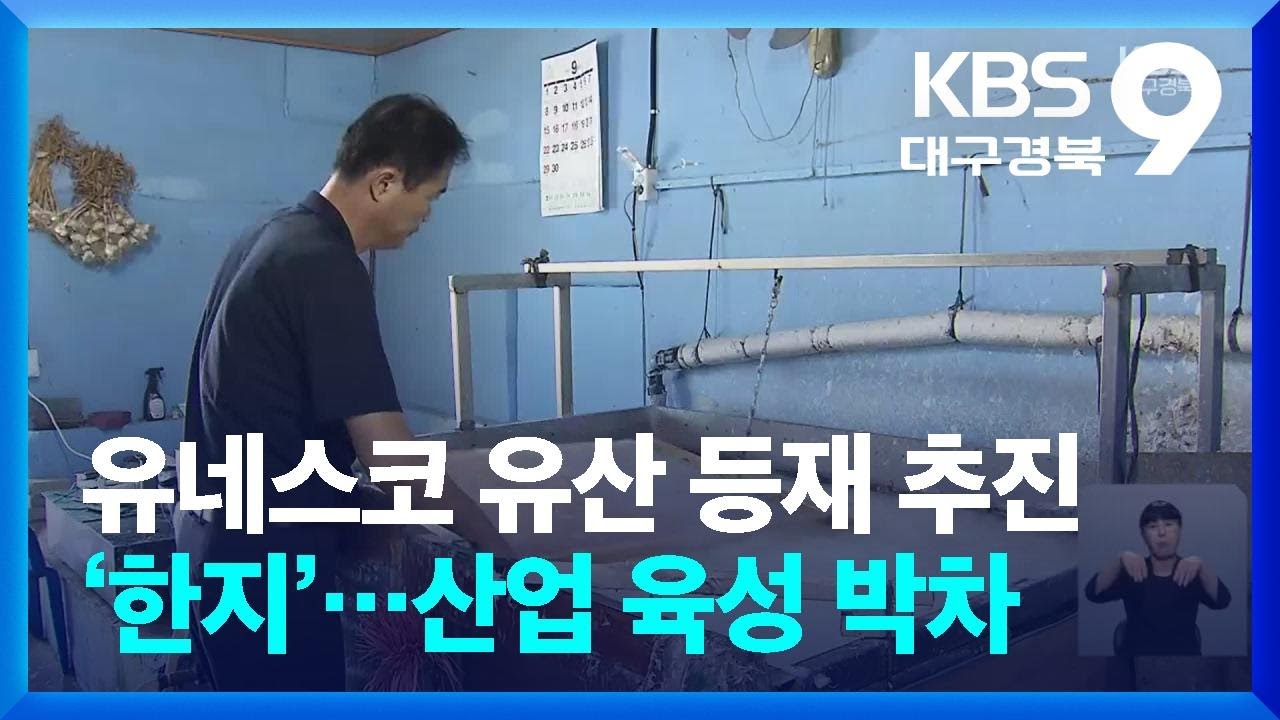
KBS News (2024) — Korea accelerates UNESCO Intangible Cultural Heritage bid for Hanji (YouTube)
Frequently Asked Questions About Hanji
What is Hanji paper made from?
Hanji is made from the inner bark of the paper mulberry tree (Broussonetia papyrifera), known in Korean as daknamuji. Only the inner white bark is used; the outer bark is removed. The bark fibres are boiled, beaten, and hand-formed into sheets using a bamboo screen.
How long does Hanji last?
Documented Hanji specimens have survived for over 1,000 years in legible condition. The oldest surviving Hanji documents date to the Unified Silla period (668–935 AD). By comparison, standard Western wood-pulp paper lasts 100–200 years before significant degradation.
Is Hanji stronger than regular paper?
Yes. Hanji is approximately three times stronger than equivalent Western paper of the same weight. This is due to its longer fibres (up to 10mm vs 1–3mm for wood pulp) and its multi-directional fibre structure, which distributes stress evenly in all directions.
What is the difference between Hanji and Japanese washi?
Both are handmade East Asian papers made from mulberry bark, but they differ in production technique and properties. Hanji uses the choiji method, where the papermaker moves the screen in multiple directions, creating a multi-directional fibre structure. Washi uses a single-directional lift. Hanji has a higher pH (7–8 vs 6–7 for washi), longer documented lifespan, and a denser, stronger sheet. Both are used in conservation, but Hanji is increasingly preferred for heavy-duty restoration work.
Why do museums use Hanji for restoration?
Hanji is used in art conservation because its alkaline pH prevents acid transfer to fragile artworks, its thin but strong sheets can be applied without adding bulk, its texture bonds well with aged materials, and it remains stable over centuries. The Louvre, the Victoria & Albert Museum, and the Vatican Library are among the institutions that use Hanji for conservation work.
Is Hanji environmentally sustainable?
Yes. Mulberry trees regrow within 3–5 years. No synthetic chemicals are used in traditional Hanji production. The finished paper is fully biodegradable and compostable. It has a significantly lower environmental footprint than wood-pulp paper, which requires clear-felling, chemical bleaching, and generates toxic effluent.
Is Hanji still made today?
Yes. Hanji is still produced by hand in Jeonju (the traditional Hanji capital of Korea), Uiryeong, Gapyeong, and other regions. The Korean government actively supports Hanji production through artisan certification programmes, the Jeonju Hanji Culture Festival, and the current UNESCO nomination campaign.
Where can I buy Hanji products in Australia?
PEUM is a Melbourne-based Korean houseware brand that brings traditional Korean craft — including Hanji-inspired homeware — to Australian homes. Browse the full range at peum.com.au, with Australia-wide shipping.
What are Hanji products used for today?
Modern Hanji products include stationery, journals, gift wrapping, lampshades, wallpaper, fashion accessories, conservation-grade archival paper, and artistic prints. Hanji is also used in interior design as a humidity-regulating wall covering. Its traditional uses — calligraphy, Buddhist scripture, and government documents — continue alongside these contemporary applications.
Can Hanji be written or printed on?
Yes. Hanji accepts ink from brushes, pens, and inkjet printers. It absorbs ink cleanly without bleeding, making it prized for calligraphy and fine art printmaking. Its texture adds a distinctive warmth and depth to printed images that cannot be replicated on smooth coated paper.
From a single mulberry branch, through the hands of a master, into a sheet that outlasts stone — Hanji is Korea’s quiet miracle. At PEUM, we celebrate the makers, the materials, and the philosophy behind Korean craft. Because the things that last are worth knowing.